

FAILINGS IN THE MATH CLASSROOM
Too often math is taught as a series of memorizations where even math games are often re-packaged drill-and-kill exercises. Life (just like great movies) is filled with open-ended journeys with open-ended questions. Students should learn not only the skills of arithmetic but also how to ask better questions to determine what is needed. The chart below shows why we so often fail in teaching open-math in the classroom.
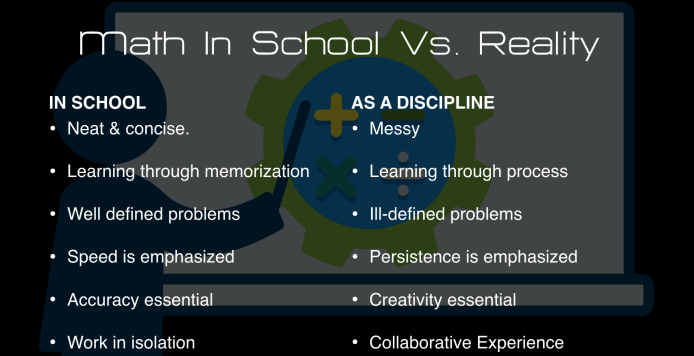
One way to open up math instruction is to make it a realistic problem or story. That framework of open storytelling is the basis of Dan Meyer’s 3-act math. Using videos, images, and applications Meyer introduces students to a central conflict, guides them to overcome obstacles, and allows students to resolve the conflict while setting up an extension/sequel.
You can find examples at G-Fletchy, Weebly, or on Dan Meyer’s spreadsheet. Find similar estimations at Estimation 180, graphing activities at Desmos, lessons and games at Math for Love, and multimedia math stories at Math Snacks.
Below is a select list of our other favorite math tools. You can also go online to find a more thorough list of math resources.
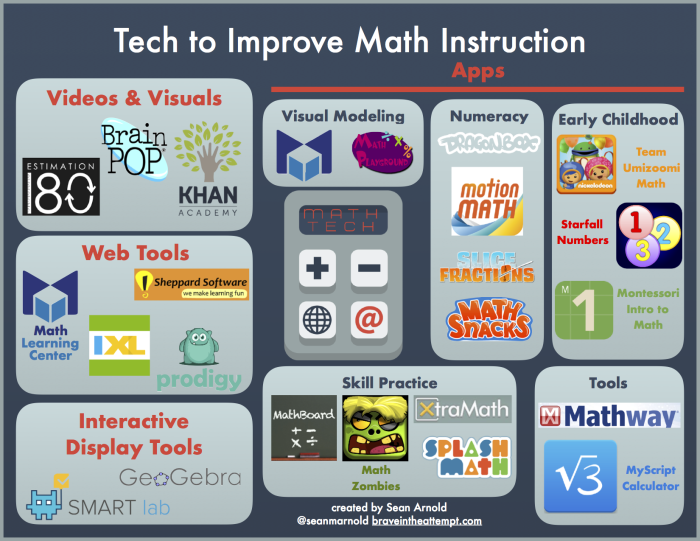
LIST OF RESOURCES
Videos and visuals
- Estimation 180 – resources based on 3-Act math
- Flocabulary Math – educational hip-hop videos
- BrainPOP Math – educational animation and games (geared towards elementary)
- BrainPOP Jr. Math – educational animation and games (geared towards early elementary)
- Math Snacks – videos paired with games
- Khan Academy – lesson walkthroughs
- TedEd – math problems and inspiration
- Crash Course – mostly science, but it includes economics and other advanced instruction
- Visual Patterns – videos and images to incorporate daily estimation that build number sense skills.
- Problem Based-Learning Curriculum Maps – 200 visual patterns from pre-school to college
- YouCubed – organization out of Stanford University that applies growth mindset and conceptual learning to mathprodigy
WEB TOOLS AND GAMES
- Math Learning Center – visual modeling apps
- Thinking Blocks – modeling apps (also
available as apps) - Greg Tang Math – math games
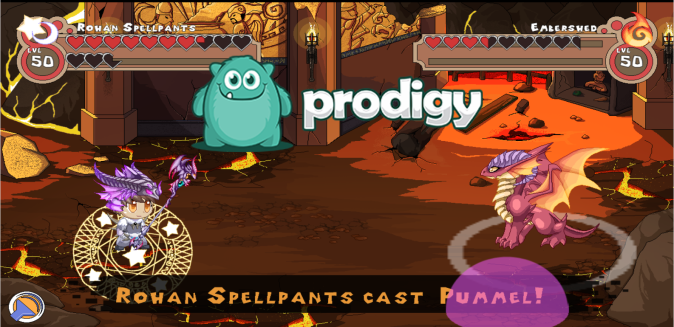
- Prodigy – math adventure game
- Sheppard Software – early learner games
- Starfall Math – early learner games
- Desmos – 3 act math geared lessons and tutorials
- IXL – review a variety of math skills
- Matific – pay site ($10 and up) with a free trial
- Get the Math – see and play with algebra in the real world
- XtraMath – practice arithmetic
- ABCya – early childhood math games
- Quadrant Defender – graphing math games
INTERACTIVE DISPLAY TOOLS
- Interactives (dice adding, fraction shapes, number lines, etc.)
- SMART Lab – game-based learning creation tool
- Activity Builder – create your own interactive tools
- Geogebra – geometry package providing for both graphical and algebraic input.
- Equation Writer – add equations to a lessons easily
TABLET APPS
VISUAL MODELING
- Math Learning Center – 10 free apps
- Thinking Blocks – 4 free apps
- OhNo Fractions– free
NUMERICAL MODELING
- DragonBox Math – 5 apps, $4.99 to $7.99, ranging from number sense to algebra and geometry
- MotionMath Games – 9 apps, $2.99 – $5.99/subscription – arithmetic, word problems, fractions, number lines, & more
- Teachley – 4 apps, Free – $4.99, arithmetic animal adventures
- Slice Fractions – $5.49, fraction adventure game
- Divide by Sheep – $2.99, puzzle game
- MathSnacks (3 Apps, Free – $2.99) – ratios, fractions, and number line games & videos
- Prodigy – Final Fantasy-like adventure game that involves math
- Pick a Path – math puzzle maze
EARLY CHILDHOOD
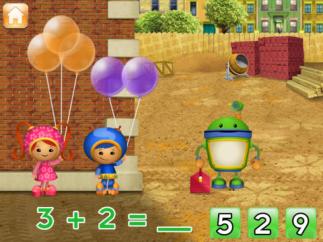
- Team Umizoomi Math – $4.99, several math games
- Starfall Numbers – $4.99, basic counting, geometry, money, and more
- Endless 123 – free, number recognition, sequences, quantity, patterns, & addition
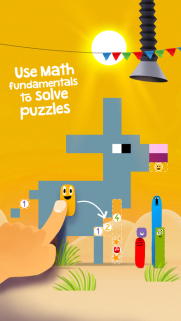
- Montessori Intro to Math – $4.99, understand numbers 0 to 9, through a series of interactive activities
- Little Digits – $2.99, count using your fingers
- Team Umizoomi Math: Zoom into Numbers ($4.99) – several games that teach basic math concepts
- Greater Gator ($.99) – number comparison game
- Montessori Counting Board ($.99) – a basic board for counting
- Montessori Geometry ($3.99) – recognize and learn shapes
- Elmo Loves 123s – ($4.99) – counting, videos, puzzles, and games
- Todo Telling Time ($4.99) – clocks and 6 mini games for time and date
- Jungle Time ($2.99) – learn time with animal face clocks
- Shapes Toddler Preschool – basic shape review and games
SKILL PRACTICE
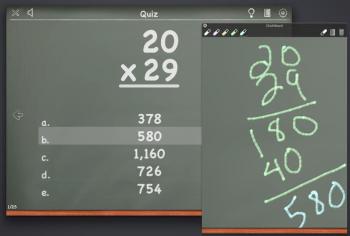
- SplashMath – grade level math skills
- MathBoard – arithmetic practice
- XtraMath – arithmetic practice
- Math Zombies – $4.99, destroy zombies with math facts
- Measure This
- Counting Money – different money skill exercises
- Quick Math (4 apps, $1.99)
- Measure This
- Counting Bills and Coins – count, match, and make change with coins and bills
- Pizza Fractions
TOOLS
- Mathway – problem solver app
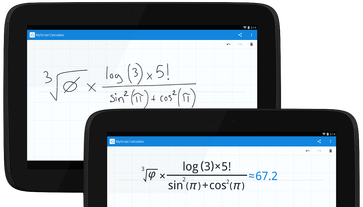
- MyScript Calculator – solve written equations
- PCalc Lite
- Free Graphing Calculator
- Mathspace (subscription, $7.99) – digital textbooks
- Math Ref ($2.99)
MATH LEARNING CENTER
The Math Learning Center is a nonprofit organization that seeks to inspire and enable individuals to discover and develop their mathematical confidence and ability. The offer a curriculum, resources, and a learning blog. Among those resources are a suite of math demonstration/exploration apps that cover a number of skills across several platforms. Among these are Fractions, Geoboard, Money Pieces, Number Frames, Number Line, Number Pieces, Number Rack, Pattern Shapes, & Vocabulary Cards. Find them for Apple, Chrome, or online. Also check out the lessons and scholarships that are available.

